Basic User Manual
This package implements an HPGe (high purity germanium detector) class which describes the detector geometry, and can be used for:
visualisation with pyg4ometry
exporting to GDML for Geant4 simulations (again with pyg4ometry)
computing detector properties
Tip
All linear dimensions in the geometry are expressed in millimetres (mm). Returned
areas, volumes and masses are pint quantities and can be converted to other units.
Metadata specification
The detector geometry is constructed based on the LEGEND metadata specification. The LEGEND HPGe detector metadata database is private.
The metadata YAML files (or Python dictionaries) describe the geometry (and other properties) for detectors:
metadata = {
    "name": "B00000B",
    "type": "bege",
    "production": {
        "enrichment": {"val": 0.9, "unc": 0.003},
        "mass_in_g": 697.0,
    },
    "geometry": {
        "height_in_mm": 29.46,
        "radius_in_mm": 36.98,
        "groove": {"depth_in_mm": 2.0, "radius_in_mm": {"outer": 10.5, "inner": 7.5}},
        "pp_contact": {"radius_in_mm": 7.5, "depth_in_mm": 0},
        "taper": {
            "top": {"angle_in_deg": 0.0, "height_in_mm": 0.0},
            "bottom": {"angle_in_deg": 0.0, "height_in_mm": 0.0},
        },
    },
}
Note
Currently BEGe, ICPC, PPC and Coax geometries are implemented as well
as a few LEGEND detectors with special geometries. Different geometries can be
implemented as subclasses deriving from HPGe.
The different keys of the dictionary describe the different aspects of the geometry. Some are self explanatory, for others:
production: gives information on the detector production, we need the “enrichment” to define the detector material,geometry: gives the detector geometry in particular,grooveandpp_contactdescribe the contacts of detector.Optional
extrasections enable special features (e.g. cracks, top grooves, bottom cylinders) for specific detector types.
Other fields can be added to describe different geometry features (more details in the legend metadata documentation).
Supported geometries
Constructing the HPGe object
The HPGe object can be constructed from the metadata with:
>>> from legendhpges import make_hpge
>>> import pyg4ometry as pg4
>>> reg = pg4.geant4.Registry()
>>> hpge = make_hpge(metadata, name="det_L", registry=reg)
>>> hpge
BEGe({...})
The metadata can either be passed as a Python dictionary or a path to a YAML/JSON file:
>>> hpge = make_hpge("path/to/metadata.yaml", registry=reg)
Important
If the production.enrichment field is present in the metadata, the material is
automatically set to enriched germanium with the corresponding \(^{76}\)Ge fraction
(approximated as a 74/76 mixture). If you pass your own material argument,
it must belong to the same Geant4 registry you pass in.
Handling asymmetries
For detectors that break cylindrical symmetry (e.g. V02160A,
P00664B), make_hpge() will build special subclasses if
allow_cylindrical_asymmetry=True (default). Set it to False to get a
symmetrized InvertedCoax or PPC shape:
>>> hpge_sym = make_hpge(
...     metadata, registry=reg, allow_cylindrical_asymmetry=False
... )
Detector properties
Most detectors are described by a
G4GenericPolycone. This
describes the solid by a series of \((r,z)\) pairs rotated around the \(z\) axis.
There are methods to plot the \((r,z)\) profile of the detector, in addition this is able to label the contact type (p+, n+ or passivated) each surface corresponds to (based on the metadata).
from legendhpges import draw

draw.plot_profile(hpge, split_by_type=True)
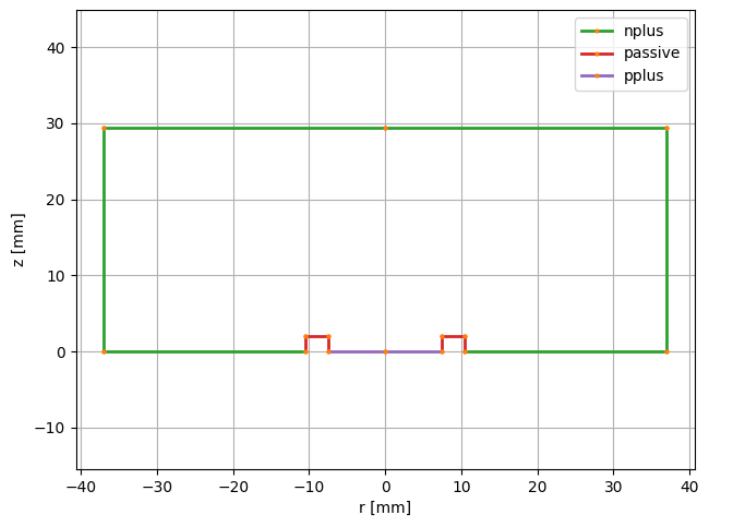
We can also directly extract the \((r,z)\) profile and the surface types and surface area of each.
>>> r, z = hpge.get_profile()
>>> hpge.surfaces
['pplus', 'passive', 'passive', 'passive', 'nplus', 'nplus', 'nplus']
>>> sum(hpge.surface_area())
<Quantity(13775.3258, 'millimeter ** 2')>
>>> hpge.surface_area(hpge.surfaces.index("nplus"))
<Quantity(2202.8546..., 'millimeter ** 2')>
Here the surfaces correspond to the line from \(r_i\) to \(r_{i+1}\) and \(z_i\) to \(z_{i+1}\).
We can also easily extract the detector mass and volume:
>>> hpge.mass
<Quantity(700.577026, 'gram')>
>>> hpge.volume
<Quantity(126226.526, 'millimeter ** 3')>
>>> # Convert to cm^3 if desired:
>>> hpge.volume.to("cm**3")
<Quantity(126.226526, 'centimeter ** 3')>
Distances and containment
Compute the shortest distance of points to the closest detector surface:
>>> # shape (N, 3), columns are x, y, z in mm
>>> hpge.distance_to_surface([(0, 0, 1), (0, 0, 99)])
array([ 1.  , 69.54])
Check whether points are inside:
>>> hpge.is_inside([(0, 0, 1), (0, 0, 99)])
array([ True, False])
Distances are computed in \((r,z)\) after converting from \((x,y,z)\). A tolerance
tol is used to treat points very close to the surface as inside.
ICPC borehole classification
For ICPC-based detectors, you can test if points are inside the borehole:
>>> from legendhpges import InvertedCoax
>>> isinstance(hpge, InvertedCoax)
True
>>> hpge.is_inside_borehole([(0, 0, hpge.metadata.geometry.height_in_mm - 1)])
array([False])
Materials
Two convenience builders are provided:
make_hpge() selects the material automatically from metadata if
production.enrichment is provided; otherwise natural germanium is used.
>>> from legendhpges.materials import make_enriched_germanium
>>> mat = make_enriched_germanium(0.92, registry=reg)
Visualisation and Geant4 usage
The HPGe object derives from pyg4ometry.geant4.LogicalVolume and can be
used to visualise the detector in 3D, or to run Geant4 simulations.
For example to visualise a detector we can use:
import pyg4ometry as pg4

# create a world volume
world_s = pg4.geant4.solid.Orb("World_s", 20, registry=reg, lunit="cm")
world_l = pg4.geant4.LogicalVolume(world_s, "G4_Galactic", "World", registry=reg)
reg.setWorld(world_l)

# place the detector
pg4.geant4.PhysicalVolume(
    [0, 0, 0], [0, 0, 0, "cm"], hpge, "det", world_l, registry=reg
)

viewer = pg4.visualisation.VtkViewerColoured()
viewer.addLogicalVolume(reg.getWorldVolume())
viewer.view()
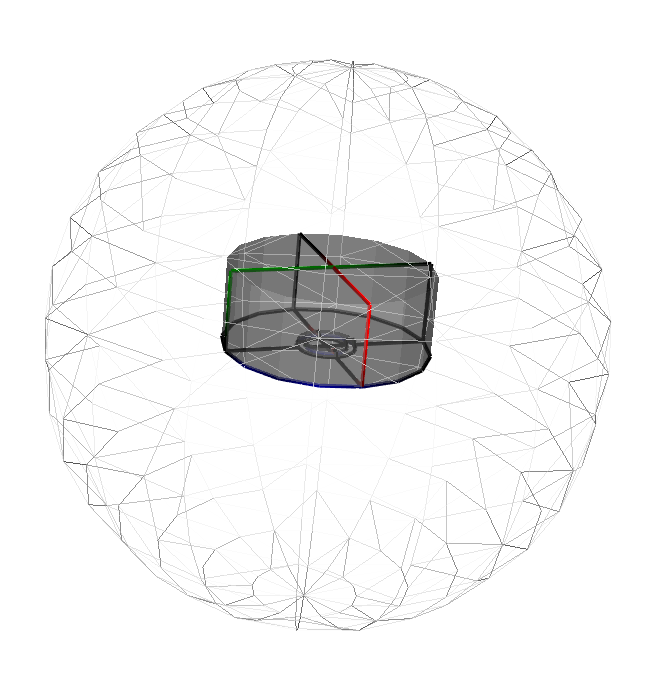
The remage tutorial gives a more complete example of using legendhpges to run a simulation.
Tips and troubleshooting
Ensure coordinate arrays are shape
(N, 3)in(x, y, z)with units of mm.A
NotImplementedErroris raised by distance methods for solids that are notpyg4ometry.geant4.solid.GenericPolycone.
Extending
New detector variants can be added by subclassing HPGe and
implementing base.HPGe._decode_polycone_coord(). For asymmetric shapes,
override base.HPGe._g4_solid() to build a CSG subtracted solid.
This package is also used in the legend-pygeom-l200 implementation of the LEGEND-200 experiment.